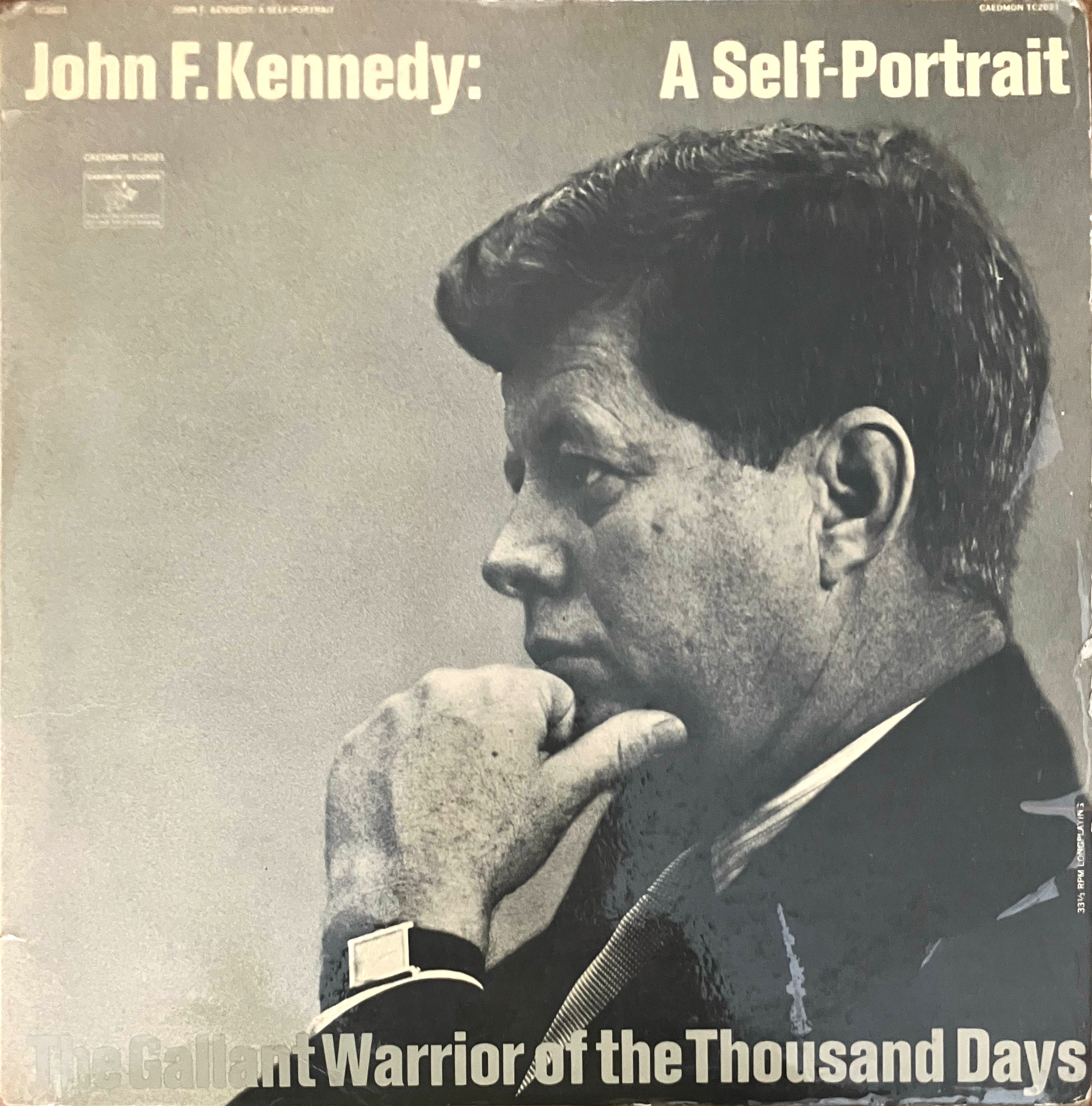
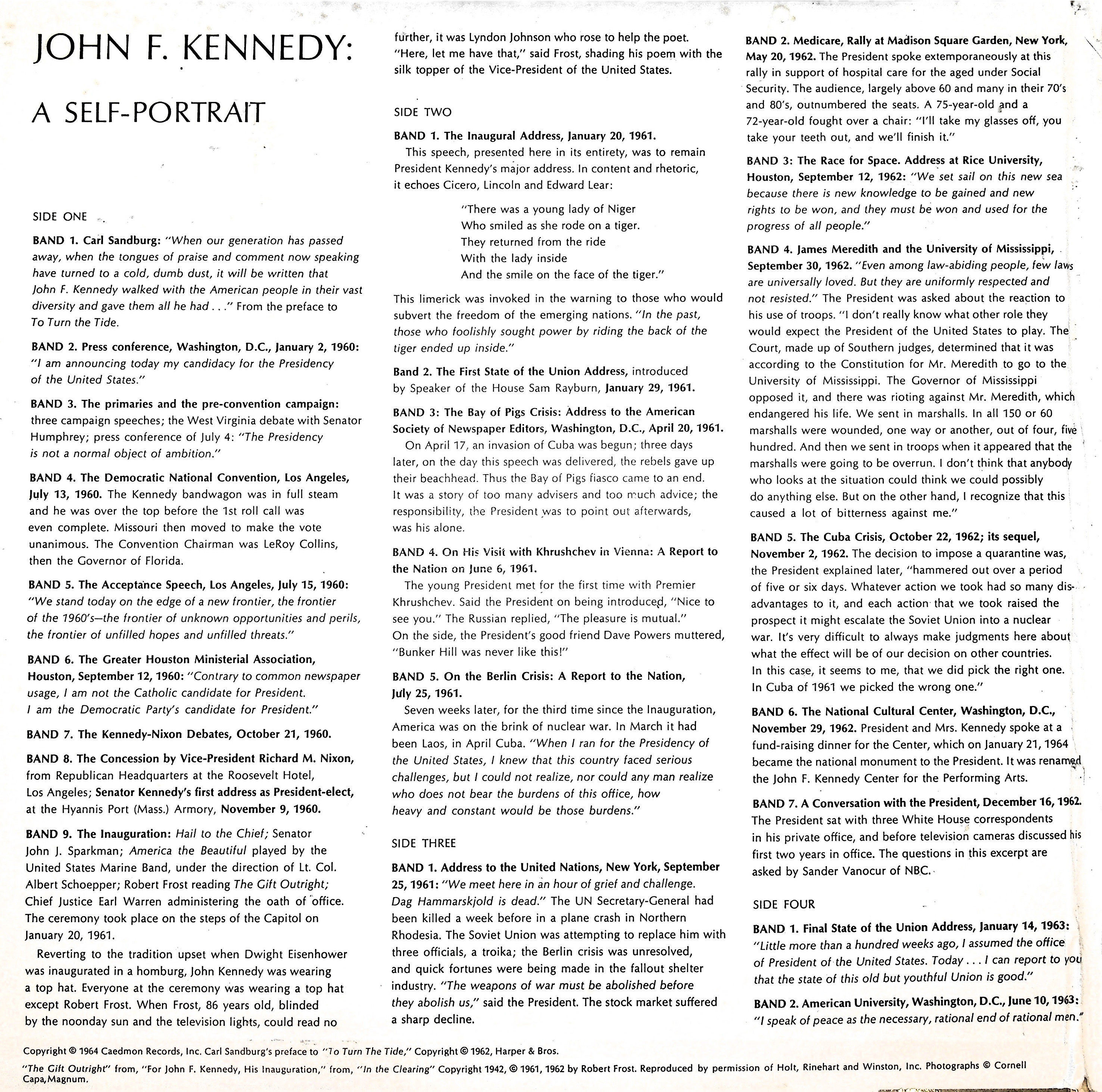
SIDE ONE (28:12)
BAND 1. Carl Sandburg: “When our generation has passed away, when the tongues of praise and comment now speaking have turned to a cold, dumb dust, it will be written that John F. Kennedy walked with the American people in their vast diversity and gave them all he had”... From the preface to To Turn the Tide.
BAND 2. Press conference, Washington, D.C., January 2, 1960: “I am announcing today my candidacy for the Presidency of the United States.”
BAND 3. The primaries and the pre-convention campaign: three campaign speeches; the West Virginia debate with Senator Humphrey; press conference of July 4: “The Presidency is not a normal object of ambition.”
BAND 4. The Democratic National Convention, Los Angeles, July 13, 1960. The Kennedy bandwagon was in full steam and he was over the top before the 1st roll call was even complete. Missouri then moved to make the vote unanimous. The Convention Chairman was LeRoy Collins, then the Governor of Florida.
BAND 5. The Acceptance Speech, Los Angeles, July 15, 1960: “We stand today on the edge of a new frontier, the frontier of the 1960’s—the frontier of unknown opportunities and perils, the frontier of unfilled hopes and unfilled threats.”
BAND 6. The Greater Houston Ministerial Association, Houston, September 12, 1960: “Contrary to common newspaper usage, I am not the Catholic candidate for President. I am the Democratic Party's candidate for President.”
BAND 7. The Kennedy-Nixon Debates, October 21, 1960.
BAND 8. The Concession by Vice-President Richard M. Nixon, from Republican Headquarters at the Roosevelt Hotel, Los Angeles; Senator Kennedy’s first address as President-elect, at the Hyannis Port (Mass.) Armory, November 9, 1960.
BAND 9. The Inauguration: Hail to the Chief; Senator John J. Sparkman; America the Beautiful played by the United States Marine Band, under the direction of Lt. Col. Albert Schoepper; Robert Frost reading The Gift Outright; Chief Justice Earl Warren administering the oath of office. The ceremony took place on the steps of the Capitol on January 20, 1961.
Reverting to the tradition upset when Dwight Eisenhower was inaugurated in a homburg, John Kennedy was wearing a top hat. Everyone at the ceremony was wearing a top hat except Robert Frost. When Frost, 86 years old, blinded by the noonday sun and the television lights, could read no further, it was Lyndon Johnson who rose to help the poet. “Here, let me have that,” said Frost, shading his poem with the silk topper of the Vice-President of the United States.
SIDE TWO (28:83)
BAND 1. The Inaugural Address, January 20, 1961.
This speech, presented here in its entirety, was to remain President Kennedy's major address. In content and rhetoric, it echoes Cicero, Lincoln and Edward Lear:
“There was a young lady of Niger
Who smiled as she rode on a tiger.
They returned from the ride
With the lady inside
And the smile on the face of the tiger.”
This limerick was invoked in the warning to those who would subvert the freedom of the emerging nations. “In the past, those who foolishly sought power by riding the back of the tiger ended up inside.”
Band 2. The First State of the Union Address, introduced by Speaker of the House Sam Rayburn, January 29, 1961.
BAND 3: The Bay of Pigs Crisis: Address to the American Society of Newspaper Editors, Washington, D.C., April 20, 1961.
On April 17, an invasion of Cuba was begun; three days later, on the day this speech was delivered, the rebels gave up their beachhead. Thus the Bay of Pigs fiasco came to an end.
It was a story of too many advisers and too much advice; the responsibility, the President was to point out afterwards, was his alone.
BAND 4. On His Visit with Khrushchev in Vienna: A Report to the Nation on June 6, 1961.
The young President met for the first time with Premier Khrushchev. Said the President on being introduced, "Nice to see you." The Russian replied, "The pleasure is mutual."
On the side, the President's good friend Dave Powers muttered, "Bunker Hill was never like this!"
BAND 5. On the Berlin Crisis: A Report to the Nation, July 25, 1961.
Seven weeks later, for the third time since the Inauguration, America was on the brink of nuclear war. In March it had been Laos, in April Cuba. "When I ran for the Presidency of the United States, I knew that this country faced serious challenges, but i could not realize, nor could any man realize who does not bear the burdens of this office, how heavy and constant would be those burdens."
SIDE THREE (28:20)
BAND 1.Address to the United Nations, New York, September 25,1961: “We meet here in an hour of grief and challenge. Dag Hammarskjold is dead.” The UN Secretary-General had been killed a week before in a plane crash in Northern Rhodesia. The Soviet Union was attempting to replace him with three officials, a troika; the Berlin crisis was unresolved, and quick fortunes were being made in the fallout shelter industry. “The weapons of war must be abolished before they abolish us,” said the President. The stock market suffered a sharp decline.
BAND 2. Medicare, Rally at Madison Square Garden, New York, May 20,1962. The President spoke extemporaneously at this rally in support of hospital care for the aged under Social Security. The audience, largely above 60 and many in their 70's and 80's, outnumbered the seats. A 75-year-old and a 72-year-old fought over a chair: "I'll take my glasses off, you take your teeth out, and we'll finish it."
BAND 3: The Race for Space. Address at Rice University, Houston, September 12, 1962: "We set sail on this new sea because there is new knowledge to be gained and new rights to be won, and they must be won and used for the progress of all people."
BAND 4. James Meredith and the University of Mississippi, September 30, 1962. “Even among law-abiding people, few laws are universally loved. But they are uniformly respected and not resisted.” The President was asked about the reaction to his use of troops. "I don't really know what other role they would expect the President of the United States to play. The Court, made up of Southern judges, determined that it was according to the Constitution for Mr. Meredith to go to the University of Mississippi. The Governor of Mississippi opposed it, and there was rioting against Mr. Meredith, which endangered his life. We sent in marshalls. In all 150 or 60 marshalls were wounded, one way or another, out of four, five hundred. And then we sent in troops when it appeared that the marshalls were going to be overrun. I don't think that anybody who looks at the situation could think we could possibly do anything else. But on the other hand, I recognize that this caused a lot of bitterness against me."
BAND 5. The Cuba Crisis, October 22, 1962; its sequel, November 2, 1962. The decision to impose a quarantine was, the President explained later, "hammered out over a period of five or six days. Whatever action we took had so many disadvantages to it, and each action that we took raised the prospect it might escalate the Soviet Union into a nuclear war. It's very difficult to always make judgments here about what the effect will be of our decision on other countries. In this case, it seems to me, that we did pick the right one. In Cuba of 1961 we picked the wrong one."
BAND 6. The National Cultural Center, Washington, D.C., November 29, 1962. President and Mrs. Kennedy spoke at a fund-raising dinner for the Center, which on January 21,1964 became the national monument to the President. It was renamed the John F. Kennedy Center for the Performing Arts.
BAND 7. A Conversation with the President, December 16, 1962. The President sat with three White House correspondents in his private office, and before television cameras discussed his first two years in office. The questions in this excerpt are asked by Sander Vanocur of NBC.
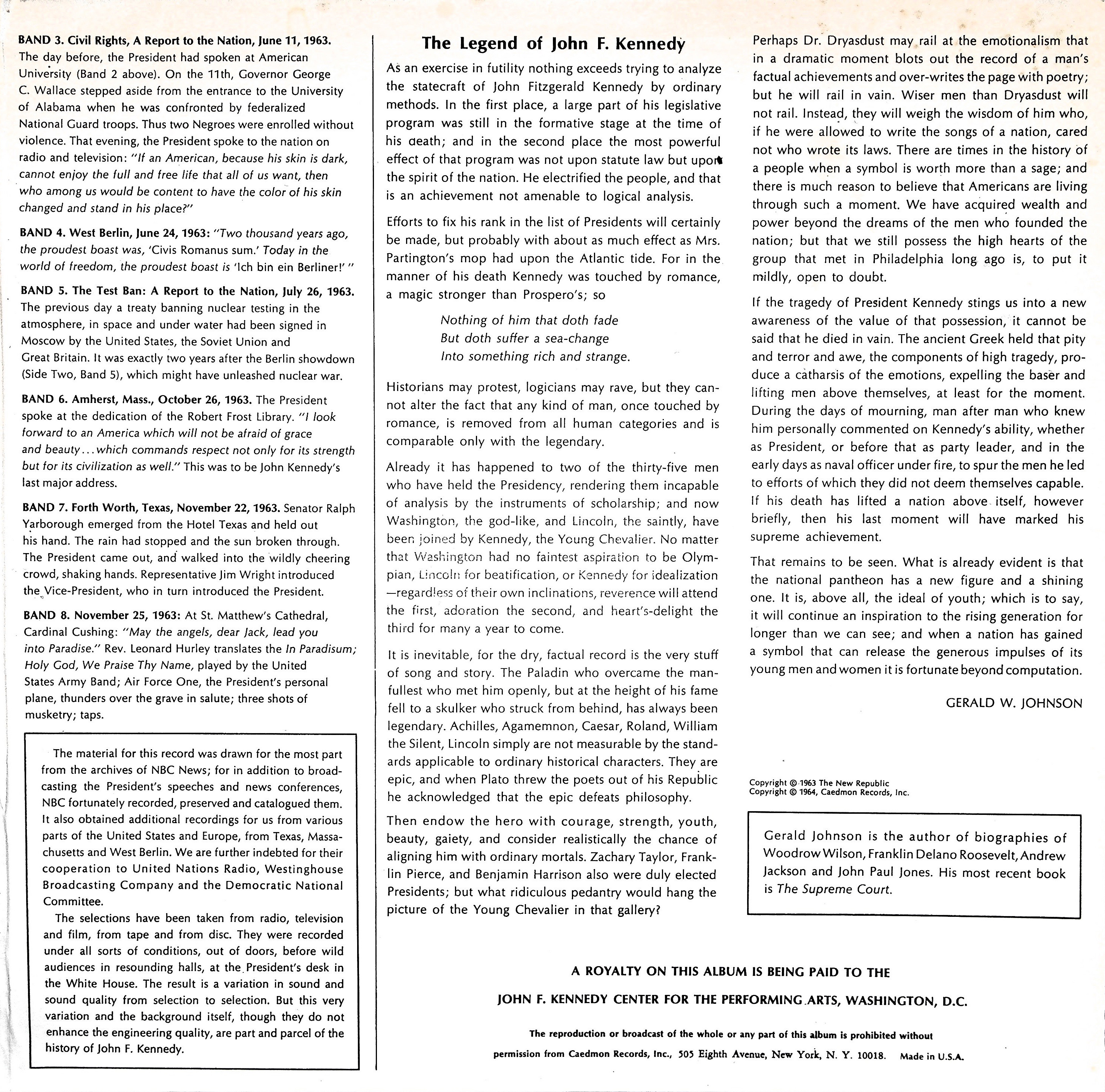
SIDE FOUR (29:04)
BAND 1. Final State of the Union Address, January 14,1963: "Little more than a hundred weeks ago, I assumed the office of President of the United States. Today.. . I can report to you that the state of this old but youthful Union is good."
BAND 3. Civil Rights, A Report to the Nation, June 11,1963.
The day before, the President had spoken at American University (Band 2 above). On the 11th, Governor George C. Wallace stepped aside from the entrance to the University of Alabama when he was confronted by federalized National Guard troops. Thus two Negroes were enrolled without violence. That evening, the President spoke to the nation on radio and television: "If an American, because his skin is dark, cannot enjoy the lull and free life that all of us want, then who among us would be content to have the color of his skin changed and stand in his place?"
BAND 4. West Berlin, June 24, 1963: "Two thousand years ago, the proudest boast was, 'Civis Romanus sum.' Today in the world of freedom, the proudest boast is 'Ich bin ein Berliner!'"
BAND 5. The Test Ban: A Report to the Nation, July 26, 1963.
The previous day a treaty banning nuclear testing in the atmosphere, in space and under water had been signed in Moscow by the United States, the Soviet Union and Great Britain. It was exactly two years after the Berlin showdown (Side Two, Band 5), which might have unleashed nuclear war.
BAND 6. Amherst, Mass., October 26, 1963. The President spoke at the dedication of the Robert Frost Library. "I look forward to an America which will not be afraid of grace and beauty... which commands respect not only for its strength but for its civilization as well." This was to be John Kennedy's last major address.
BAND 7. Forth Worth, Texas, November 22,1963. Senator Ralph Yarborough emerged from the Hotel Texas and held out his hand. The rain had stopped and the sun broken through. The President came out, and walked into the wildly cheering crowd, shaking hands. Representative Jim Wright introduced the Vice-President, who in turn introduced the President.
BAND 8. November 25, 1963: At St. Matthew's Cathedral, Cardinal Cushing: "May the angels, dear jack, lead you into Paradise." Rev. Leonard Hurley translates the In Paradisum; Holy Cod, We Praise Thy Name, played by the United States Army Band; Air Force One, the President's personal plane, thunders over the grave in salute; three shots of musketry; taps.
The material for this record was drawn for the most part from the archives of NBC News; for in addition to broadcasting the President's speeches and news conferences, NBC fortunately recorded, preserved and catalogued them. It also obtained additional recordings for us from various parts of the United States and Europe, from Texas, Massachusetts and West Berlin. We are further indebted for their cooperation to United Nations Radio, Westinghouse Broadcasting Company and the Democratic National Committee.
The selections have been taken from radio, television and film, from tape and from disc. They were recorded under all sorts of conditions, out of doors, before wild audiences in resounding halls, at the President's desk in the White House. The result is a variation in sound and sound quality from selection to selection. But this very variation and the background itself, though they do not enhance the engineering quality, are part and parcel of the history of John F. Kennedy.
The Legend of John F. Kennedy
As an exercise in futility nothing exceeds trying to analyze the statecraft of John Fitzgerald Kennedy by ordinary methods. In the first place, a large part of his legislative program was still in the formative stage at the time of his death; and in the second place the most powerful effect of that program was not upon statute law but uport the spirit of the nation. He electrified the people, and that is an achievement not amenable to logical analysis.
Efforts to fix his rank in the list of Presidents will certainly be made, but probably with about as much effect as Mrs. Partington's mop had upon the Atlantic tide. For in the manner of his death Kennedy was touched by romance, a magic stronger than Prospero's; so
Nothing of him that doth fade
But doth suffer a sea-change
Into something rich and strange.
Historians may protest, logicians may rave, but they cannot alter the fact that any kind of man, once touched by romance, is removed from all human categories and is comparable only with the legendary.
Already it has happened to two of the thirty-five men who have held the Presidency, rendering them incapable of analysis by the instruments of scholarship; and now Washington, the god-like, and Lincoln, the saintly, have been joined by Kennedy, the Young Chevalier. No matter that Washington had no faintest aspiration to be Olympian, Lincolr: for beatification, or Kennedy for idealization —regardless of their own inclinations, reverence will attend the first, adoration the second, and heart's-delight the third for many a year to come.
It is inevitable, for the dry, factual record is the very stuff of song and story. The Paladin who overcame the man-fullest who met him openly, but at the height of his fame fell to a skulker who struck from behind, has always been legendary. Achilles, Agamemnon, Caesar, Roland, William the Silent, Lincoln simply are not measurable by the standards applicable to ordinary historical characters. They are epic, and when Plato threw the poets out of his Republic he acknowledged that the epic defeats philosophy.
Then endow the hero with courage, strength, youth, beauty, gaiety, and consider realistically the chance of aligning him with ordinary mortals. Zachary Taylor, Franklin Pierce, and Benjamin Harrison also were duly elected Presidents; but what ridiculous pedantry would hang the picture of the Young Chevalier in that gallery?
Perhaps Dr. Dryasdust may rail at the emotionalism that in a dramatic moment blots out the record of a man's factual achievements and over-writes the page with poetry; but he will rail in vain. Wiser men than Dryasdust will not rail. Instead, they will weigh the wisdom of him who, if he were allowed to write the songs of a nation, cared not who wrote its laws. There are times in the history of a people when a symbol is worth more than a sage; and there is much reason to believe that Americans are living through such a moment. We have acquired wealth and power beyond the dreams of the men who founded the nation; but that we still possess the high hearts of the group that met in Philadelphia long ago is, to put it mildly, open to doubt.
If the tragedy of President Kennedy stings us into a new awareness of the value of that possession, it cannot be said that he died in vain. The ancient Creek held that pity and terror and awe, the components of high tragedy, produce a catharsis of the emotions, expelling the baser and lifting men above themselves, at least for the moment. During the days of mourning, man after man who knew him personally commented on Kennedy's ability, whether as President, or before that as party leader, and in the early days as naval officer under fire, to spur the men he led to efforts of which they did not deem themselves capable. If his death has lifted a nation above itself, however briefly, then his last moment will have marked his supreme achievement.
That remains to be seen. What is already evident is that the national pantheon has a new figure and a shining one. It is, above all, the ideal of youth; which is to say, it will continue an inspiration to the rising generation for longer than we can see; and when a nation has gained a symbol that can release the generous impulses of its young men and women it is fortunate beyond computation.
GERALD W. JOHNSON
Copyright © 1963 The New Republic
Copyright © 1964, Caedmon Records, Inc.
Gerald Johnson is the author of biographies of Woodrow Wilson, Franklin Delano Roosevelt, Andrew Jackson and John Paul Jones. His most recent book is The Supreme Court.
A ROYALTY ON THIS ALBUM IS BEING PAID TO THE
JOHN F. KENNEDY CENTER FOR THE PERFORMING ARTS, WASHINGTON, D.C.
The reproduction or broadcast of the whole or any part of this album is prohibited without permission from Caedmon Records, Inc., 505 Eighth Avenue, New York, N. Y. 10018. Made in U.S.A.
Copyright © 1964 Caedmon Records, Inc. Carl Sandburg's preface to "To Turn The Tide," Copyright © 1962, Harper & Bros.
"The Gift Outright" from, "For John F. Kennedy, His Inauguration," from, "In the Clearing" Copyright 1942, © 1961, 1962 by Robert Frost. Reproduced by permission of Holt, Rinehart and Winston, Inc. Photographs © Cornell Capa, Magnum.
back to JFK | ratville times | rat haus | Index | Search | tree